
Skip to content
KalkyBook a pilot

Only humans get in.

Kalky makes sure an AI cannot change anything important unless the right person approves it first.

Working today as a tested proof of concept, and ready for a first pilot.

AI assistants now act on their own.

AI assistants are being given access to real systems: customer records, payments, cloud accounts. They work around the clock, and they are fast.

Today’s security asks one question: is this account allowed? Nothing asks the question that matters: did a person actually mean this?

A night city with red swarms of agents winding between the towers.
Illustration. Not a real incident.

Without Kalky

  1. The requestAn AI assistant decides to cancel every pending customer order.
  2. The checkIs the assistant allowed into the orders system? Yes.
  3. What happens41,280 orders are cancelled in seconds, before anyone notices.

With Kalky

  1. The requestThe same assistant tries to cancel every pending order.
  2. The checkHas a person approved this? Not yet.
  3. What happensNothing is cancelled. The duty manager gets a request on their phone, sees exactly what was asked, and can say no.

Kalky in plain words.

Think of a cheque. Your AI assistant can fill it in, but only a person can sign it. Each signature works once, for that cheque only.

  1. The AI asks

    An AI assistant asks to do something important, just as it does today. Kalky holds the request. Nothing happens yet.

  2. A person checks

    The right person sees exactly what will happen, in plain words, and approves it on their phone with a fingerprint or face.

  3. It happens once

    The action runs exactly as approved, one time. Any change to it, or any second attempt, is refused.

Try it. This runs only in your browser; nothing is sent anywhere.

Request from an AI assistantWaiting

Assistant  Ops assistant
Wants to   Cancel pending orders
Which      Older than 30 days
System     Orders

Press and hold the ring, or hold Space. About one second.

Held. Nothing has happened. Waiting for a person to approve.

What Kalky does, with real examples.

Start with the gate: a person approves every important action. That alone delivers the promise, and it is all a first pilot needs. The layers further down add more protection when you are ready.

The gate

Optional layers, added when you are ready

A gold castle dissolving into light as a red wireframe hand reaches for it and finds nothing.

Kalky Cloak

Built and tested

Systems an AI cannot even see.

Your important systems disappear from the network for anything that has not been approved by a person. There is no door to knock on.

For exampleAn AI assistant scans the network looking for the customer database. It finds nothing: no address, no door, no answer.


A red wireframe agent wrapped in a glowing gold web.

Kalky Web

Built and tested

Decoys that catch a misbehaving AI.

Kalky leaves convincing fakes where a misbehaving AI would look: fake databases, fake files, fake passwords. No real person is ever sent there, so anything that touches them is caught.

For exampleAn assistant finds a “database password” in a document and tries it. It is a trap. Within seconds the assistant is locked out everywhere, its waiting requests are frozen, and the security team has the full record. Nothing real was ever at risk.

A red wireframe figure pressing its hand against a vast gold ring that has caught it.

Kalky Watch

Built and tested

A security guard that never sleeps.

Watch looks at every action for the things that should never happen, and alerts your security team the moment one does.

For exampleAn account approves forty requests in one minute, faster than anyone could read them. Watch flags it to the security team in Microsoft Teams.

A human hand on a gold ring, sending light along a chain of gold blocks.

Your private record book

Built and tested

A record no one can quietly rewrite.

Each organisation keeps its own tamper-evident record of who may approve and when evidence was sealed. It never holds names, emails or personal data.

For exampleSix months later an auditor asks who approved a change. The answer is checked against your own record book, which nobody could have altered after the fact.

A red agent breaking apart at the threshold of a tall gold doorway.

Kalky Prod Shield

Tested on a simulator

Live systems hidden inside shared cloud accounts.

Where developers and live systems share one cloud account, AI accounts are given no view of the live side at all.

For exampleIn a Microsoft Azure account shared by test and live systems, an AI account cannot even list the live ones. It only ever sees the test side.

Our vision: every important AI action traces back to a person who meant it.

AI assistants will soon act inside every bank and every large organisation. Today’s security was built to check accounts, not intent. Kalky’s aim is to be the simple, standard proof that a person approved an action, working alongside the security you already trust rather than replacing it.

Our order is deliberate. We start where an unapproved action costs most and where the change is smallest: one gateway in front of one system. Then we extend the same pattern, a gateway at the door with a person approving each action, to new kinds of systems and new threats.

  1. Now

    Banks

    Built and tested

    HowThe Kalky gateway in front of one system that matters, such as payments or customer data, using the bank's own sign-in. Daily value limits, two-person approval for the highest risks, and a sealed record for auditors.

    WhyBanks are where an unapproved AI action costs most, and where regulators expect proof of control. A single-system pilot shows that proof without touching core banking.

  2. Now

    Enterprises

    Built, with limits

    HowThe same gateway in front of databases, file storage, internal services and cloud accounts, alongside tools companies already use, such as CyberArk and Microsoft Entra.

    WhyEvery organisation adopting AI assistants has the same gap: today's tools check that an account is allowed, not that a person meant this action. Open standards mean no rip-and-replace.

  3. Next

    Ready for production at a bank

    Design stage

    HowApproval keys in hardware security modules, certified hardware security keys for approvers, real identity checks by a chosen provider in each region, and the record book spread across separate sites.

    WhyThe proof of concept shows the guarantee works. These are the parts a bank's own security team will require before it runs on live systems.

  4. Next

    Mainframes and older systems

    Design stage

    HowThe gateway sits at the mainframe's front door: its service interface or message queue. No software is installed on the mainframe, and every other path is closed.

    WhyMuch of banking still runs on mainframes. Protecting new systems while the oldest stay open would leave the back door unlocked.

  5. Next

    Digital assets

    Design stage

    HowA Kalky gateway in front of the custody provider or signing service. Each approved transaction gets a short-lived authorisation for one amount, one destination, one asset. Kalky never holds a key that can move funds.

    WhyA digital asset transfer cannot be reversed. A person approving each exact transfer is the strongest control there is, and it follows the same pattern Kalky already uses.

  6. Later

    Post-quantum threats

    Design stage

    HowKalky approvals last sixty seconds, so a future quantum computer cannot forge one after the fact. The real exposure is long-lived keys and network traffic recorded today, so the next step is quantum-resistant encryption for Kalky's own connections, already scoped.

    WhyNo real-world key has been broken by a quantum computer yet, but regulators now ask for plans: FINMA expects Swiss banks to have one by mid-2027, the G7 published a roadmap for finance in January 2026, and NIST plans to phase out today's algorithms by 2030.

Design-stage items are planned and designed but not yet built or tested. We will not claim them until they are.

For your engineers.

The rest of this page is for platform and security engineers: how the protocol works, how it fits your stack, and the test evidence behind every claim above.

How the gate works, step by step.

Kalky sits in front of the systems you care about. Agents keep working as they do now; anything that changes production waits for a person, and runs once.

  1. Propose

    The agent sends its request as it always would. The enforcement point canonicalises it (RFC 8785) and hashes the exact operation and parameters.

  2. Park

    A governed request is answered 202 KAP_PENDING_HUMAN. Nothing runs, and the agent holds no credential that could run it another way.

  3. Prove

    An approver sees what will happen, in plain words, and signs that hash with a passkey. KH2 adds a verified identity and a second enrolled device.

  4. Execute once

    Kalky issues a one-time capability bound to that request and to the enforcement point's key: Ed25519, sixty seconds, consumed once. The parked request runs once.

It fits the stack you already run.

Kalky is a set of enforcement points and brokers between agents and your systems, built on open standards you already use: WebAuthn passkeys, SCIM from your HR feed, MCP for agent tools, and plain HTTP. It adds proof of a human; it does not replace the controls you trust.

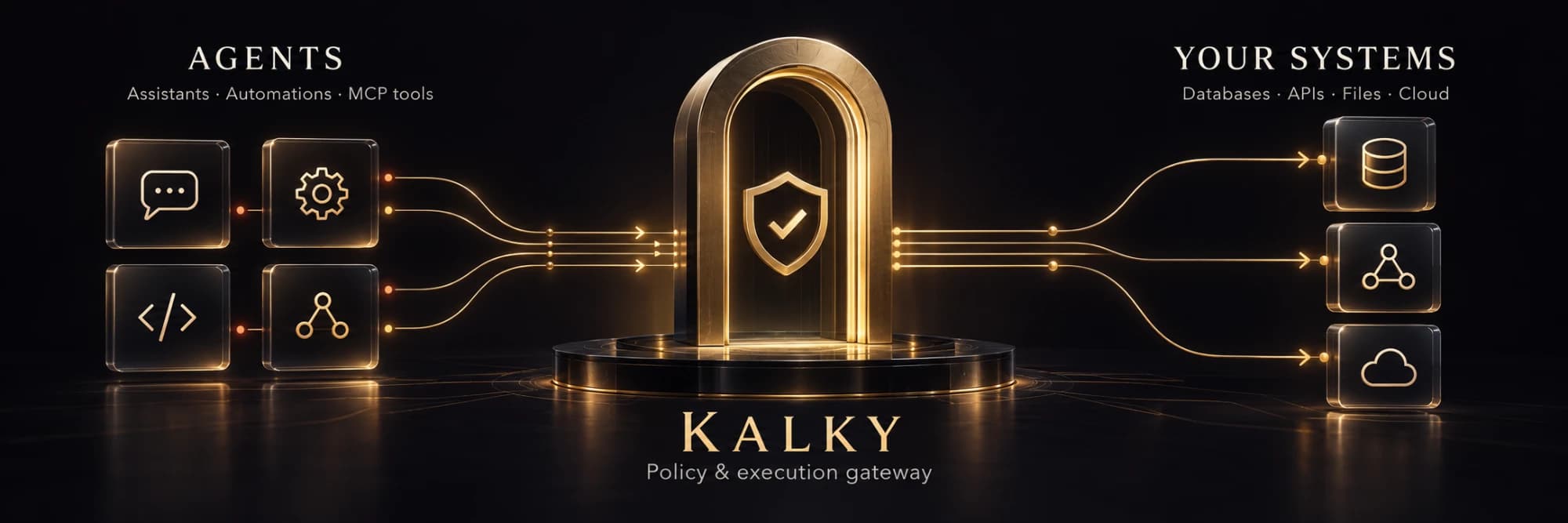
Agents, such as assistants, automations and MCP tools, connect only through the Kalky gateway, shown as a gold arch with a shield, which then reaches your systems: databases, APIs, files and cloud.

Respects what is already there

  • No TLS interception. Kalky runs behind your WAF, IDS and firewalls.
  • A capability never overrides a denial from the WAF, EDR, DLP or the application.
  • Complements privileged access tools such as CyberArk: they secure agent identities; Kalky proves a person approved the action.
  • Complements Microsoft Entra Agent ID: Entra says which agent this is; Kalky proves which person allowed this exact action.
  • Employees come from your HR feed over SCIM and sign in with your identity provider.
  • Signing keys sit behind a KMS or HSM interface.

Does not drown people in prompts

  • Policy decides per operation: some calls run without a human, some need KH1, some KH2.
  • Identical proposals wait once (409 KAP_DUPLICATE), so a swarm produces one prompt, not hundreds.
  • Repetitive automation runs as a human-signed job inside a manifest someone else approved at KH2.
  • Approval fatigue is a watched signal (W07), not a hidden risk.
  • Credentials for the call are minted after approval and expire in minutes.

The protocol.

Three proofs make a human: a unique person (one HR record and an identity check at IAL2 or IAL3), a present person (a user-verified WebAuthn passkey), and an intended action (the passkey signs the canonical hash of this request).

Human assurance levels
LevelEvidenceUsed for
KH0Credentials, tokens or sessions onlyNot human. Governed actions are denied.
KH1A user-verified passkey bound to the employee's Kalky credentialLow-risk reads; moderate writes where policy allows
KH2A passkey bound to an identity verified at IAL2 or IAL3, confirmed on a second enrolled deviceProduction changes, deletes, exports, privilege changes, secrets, job approval. Two people for the highest risk.
A capability’s claims (synthetic example). Signed Ed25519 JWS, held by the enforcement point, never by the agent.
{
  "iss": "https://kalky.acme.example/tenant/acme",
  "aud": "urn:acme:orders-api",
  "sub": "ksub_opaque_pairwise_value",
  "jti": "01J8K7H3D7W0S5Q9N7K2A6V8C1",
  "iat": 1790413200, "exp": 1790413260,
  "human": { "level": "KH2", "presence": "webauthn_uv" },
  "op": "orders.cancel",
  "params_hash": "sha256-5c1b…e930",
  "cnf": { "jkt": "thumbprint-of-enforcement-point-key" }
}
What a caller can be told
StatusCodeMeaning
202KAP_PENDING_HUMANParked, waiting for a verified person
403KAP_NON_HUMANNo human evidence, and the route forbids parking
403KAP_POLICY_DENYDenied by policy; no approval can override a forbid
403KAP_VALUE_CAPWould exceed the approver's cumulative daily value cap
409KAP_REPLAYEDCapability or challenge already consumed
409KAP_BINDING_MISMATCHThe live request differs from what was approved
410KAP_EXPIREDChallenge, session, job or capability expired
503KAP_VERIFIER_UNAVAILABLEVerification unavailable; nothing executed

The employee credential is a W3C Verifiable Credential 2.0 with a pairwise subject and a status list whose hash is anchored on your chain. A lost key means proving identity again, never a helpdesk reset. The full specification is not public yet; ask for a walk-through.

It works today.

Every capability in the proof of concept closed on a pass or fail test. Under load, enforcement made 600,000 decisions at 1,000 a second beside the replay store over TLS: median 2.3 ms, 99th percentile 4.3 ms. Of 6,000 capabilities presented a second time, none was accepted.

Exit tests
What was provenTestsResult
Parked execution with a real agentT01Pass
Brokers mint short-lived credentials; no standing accessT02, T07, T08Pass
Enrolment, verified identity and KH2 approval with a passkeyT03, T18Pass
Canonical binding, capability signing, single consumptionT04, T05, T06Pass
Watch rules, alerts and human-signed jobsT09, T10, T11, T13Pass
Verifier or replay store down, or clock drift: fails closed, then runs exactly onceT12Pass
Load: 600,000 decisions at 1,000 a second, p99 under 10 ms, nothing consumed twiceT14Pass
Private chain sync, revocation and fail-closed stalenessT15, T16, T17Pass
Cloak: no host, port or name found; no answer to direct dialsT19, T20, T21Pass
Kalky Web: decoys only, W11 within 5 s, agent kept engagedT22 to T26Pass
Prod Shield and harness integration (tenant simulator)T27 to T31Pass
Daily value cap per approver (KAP_VALUE_CAP)T32Pass
Decoy touch contains every agent seen at that addressT33Pass

What is not proven yet

  • Prod Shield ran against a tenant simulator, not a live Azure tenant.
  • Hardware-key attestation (FIPS FIDO2) is a policy switch, waiting on the keys; the tests used platform passkeys.
  • Identity proofing was simulated; the production providers are still to be chosen per region.
  • Cloak does not hide what a signed-in employee’s own session can see. Per-action approval and Watch cover agents inside a human session.
  • No customer runs Kalky in production yet. That is what the pilot is for.
The Kalky seal: a gold wheel of twenty-four notches around a standing human.

Bring Kalky to one system that matters.

We are looking for a small number of design partners: banks, data platforms and any team whose production an agent could reach. A pilot puts the Kalky gateway in front of one system you choose, working with your identity provider. There is nothing else to stand up: no new network and no chain. The other layers come later, if you want them.

We can walk security leaders through the guarantee and the evidence, platform engineers through the protocol and the test results, and investors and partners through both.

Preview: booking is not connected yet, so this form sends nothing. The contact route is still to be added.